
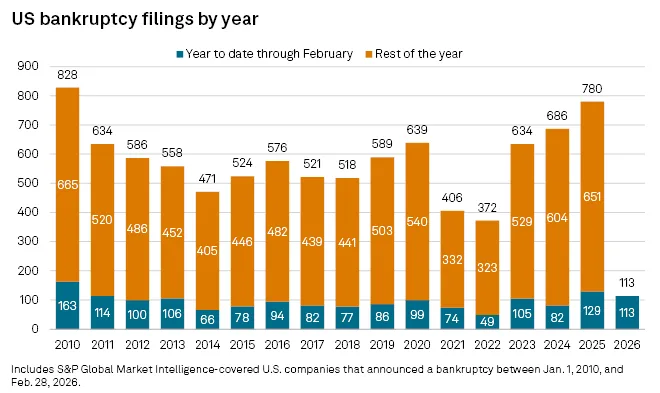
U.S. corporate bankruptcy filings showed a modest decline in February, offering a short-term signal of stabilization after elevated levels in prior months. According to data from the S&P Global Market Intelligence, 55 companies filed for bankruptcy during the month, down from 58 in January. While the decrease suggests some easing in near-term distress, overall filing levels remain higher than in previous years, indicating that financial pressure across corporate sectors has not fully subsided.
The data reflects a business environment still shaped by higher borrowing costs and tighter financial conditions. Many companies continue to face challenges related to debt servicing, refinancing, and maintaining liquidity. Although some firms have been able to adjust or delay financial strain, others remain vulnerable. The month-to-month decline does not signal a full recovery but rather highlights how corporate distress can fluctuate as companies respond to changing market conditions.
Bankruptcy activity continues to vary by sector, with certain industries experiencing more pressure than others. Companies that took on significant debt during earlier periods of low interest rates are now navigating a more expensive capital environment. As a result, even a temporary drop in filings does not eliminate the broader trend of financial strain that has been building over time. Investors and market participants are closely watching these patterns to assess the health of the corporate sector and the potential for future defaults.
The Cardiff Connection
Dean Lyulkin, CEO of Cardiff, addressed the decline in February bankruptcies, noting that a single month of lower filings does not signal that financial stress has fully eased. He noted that many companies are still operating under pressure from higher interest rates and tighter credit conditions, even though fewer firms filed for bankruptcy during the month.
Lyulkin explained that the current environment continues to challenge businesses that rely on refinancing or carry elevated debt levels. As borrowing costs remain high, companies with weaker financial positions may still face difficulty managing obligations, which can delay, but not eliminate, the risk of future distress. This means that short-term improvements in bankruptcy numbers should be viewed with caution.
Lyulkin’s comments highlight the importance of looking beyond headline data to understand underlying financial conditions. A temporary decline in filings can mask ongoing strain in the corporate sector, particularly in industries more sensitive to interest rates and credit availability.
By focusing on how various financial pressures interact, Cardiff helps clients better interpret shifts in bankruptcy trends. This approach allows small business owners to assess whether changes in corporate distress reflect meaningful improvement or continued pressure building beneath the surface.
Press & media
Writing about this story? Reach the Cardiff team at media@cardiff.co.
Questions
Call 888-234-0166 or browse the FAQs.